
WNT/β-catenin와 Ras/MAPK 경로 조절을 통한 Isoalantolactone (ISA)의 모발 성장 효과
Abstract
Hair loss is a significant concern in modern society, often leading to psychological stress and low self-esteem. This study explores the potential of isoalantolactone (ISA), a natural compound, as a preventive and therapeutic agent for hair loss. ISA activates the WNT/β-catenin signaling pathway, which plays a crucial role in hair follicle regeneration and growth, and promotes the proliferation of hHDFP cells. Additionally, ISA enhances hair cell growth by upregulating Erk1/2, a key component of the RAS/MAPK pathway, and indirectly prevents β-catenin degradation by regulating WNT signaling, thereby accelerating early hair growth. In a C57BL/6 mouse model, ISA administration significantly improved hair growth and increased hair thickness compared to the control group. These findings suggest that ISA may serve as a promising novel treatment for hair loss by stimulating hair growth.
Keywords:
Hair cell growth, Hair loss, Isoalantolactone (ISA), WNT/β-catenin, Ras/MAPK탈모는 현대인의 삶에서 많은 영향을 미치고 있는 질환으로 생명에는 위협이 없으나 자신감 저하, 우울, 대인기피 등 다양한 심리적 스트레스가 유발할 수 있다. 이러한 탈모는 성별을 가리지 않고 발생하며 식습관, 생활환경 등 다양한 요인을 원인으로 지목되고 있다.1,2) 탈모는 모발의 밀도가 감소하거나 가늘어져 빠지는 현상으로 모낭과 관련이 깊다. 모낭은 자가 재생 능력이 있으며 일생동안 성장기(anagen phase), 퇴행기(catagen phase), 휴지기(telogen phase)의 3가지 주기를 반복한다. 먼저 모낭의 성장기인 anagen 단계는 모낭 세포가 활발히 분열하며 모발이 적극적으로 성장하는 주기이다. 모발의 약 90%가 이 단계에 속하며 보통 2~6년간 지속된다. 다음으로 퇴행기인 catagen 단계는 약 2~3주간 지속되고 모발의 구근 상피세포, 외부 근초 및 최외측 상피층에 세포 자멸사가 증가하고 세포 순환이 감소하여 모발은 점차 위축되어 성장이 정지하게 된다. 그 이후 휴지기인 telogen 단계는 약 2~4개월 지속되며 이 단계에서 모발은 휴식기에 들어가고 과정이 끝나면 모발이 탈락하게 된다.3,4)
이러한 모낭 주기는 다양한 세포 신호 전달 경로의 조절을 받으며, 그 중에서도 WNT/β-catenin 경로는 모낭의 성장 및 재생을 유도하는 핵심 기전으로 알려져 있다. Wnt/β-catenin은 Frizzled에 결합하는 당단백질로 이 신호가 활성화되면 GSK3β 복합체가 low-density lipoprotein receptor-related protein 5/6 (LRP5/6)를 인산화하고 인산화 된 LRP5/6는 Axin을 통해 β-catenin의 인산화를 차단하고 β-catenin은 핵 안으로 전위되어 T cell factor/lymphoid enhancer factor (TCF/LEF)와 결합한다.5,6) 따라서 WNT/β-catenin 신호는 모낭의 형태형성 및 재생에 중요한 역할을 한다. 배아 표피에서 β-catenin을 제거하면 모낭 형성이 이루어지지 않으며 반대로 발현시키면 성인에서 모낭이 새로 형성된다.5,6) 또한 WNT/β-catenin 신호가 활성화되면 영구 모낭에서 각질 세포를 활성화하여 모낭 재생을 시작하는 중요한 역할을 한다.7) 모발 주기 조절에 관여하는 또 다른 중요한 신호는 Janus kinase–signal transducer and activator of transcription (JAK-STAT) family 중 하나인 STAT6 경로이다. STAT6는 IL-4와 IL-13에 의해 활성화되며 IL-4는 IL-4Rα와 높은 친화성으로 결합하여 Jak1 및 Jak3를 활성화하고 STAT6 단량체를 인산화 한 다음 동종 이량체화 하여 핵 안으로 전위 후 STAT6 표적 유전자 발현을 통해 모낭 세포 성장, 증식 등을 억제한다.8) 위의 모낭 성장을 조절하는 WNT/β-catenin 과 Janus kinase–signal transducer and activator of transcription (JAK-STAT) 표적단백질들은 현재 탈모 치료제로 미국 식품의약국(Food and Drug Administration, FDA)에 승인을 받은 혈관확장제인 미녹시딜(minoxidil)과 5α-환원효소 억제제(5α-reductase inhibitor)인 피나스테라이드(finasteride) 같은 화합물이 갖고 있는 피부자극, 발진, 홍반부터 심한 경우 성기능 장애 등의 부작용9,10)들을 개선할 수 있는 새로운 기전 치료제의 가능성을 가지고 있다. 또한 약용 식물은 수많은 현대 의약품의 보편적인 응용되어 왔다. 식물 추출물을 모발 성장 촉진제로 사용하는 용도가 오랫동안 이어져 왔기 때문에, 우리는 다양한 식물 추출물의 모발 성장 촉진 및/또는 탈모 예방 효과에 대한 체계적인 과학적 검증을 진행하였다.11,12) 또한 많은 연구결과에서는 여러 식물 추출물의 모발 성장 및 탈모 억제 효과가 보고되었다.13-15) 본 연구에서 모발 성장 효능 평가를 위해 사용한 Isoalantolactone (ISA)는 Fig. 1의 화학 구조이며 국화과에 속하는 많은 식물의 잎과 뿌리에 존재하는 천연 화합물로써 발표된 연구 결과에 따르면 항균, 항진균, 항염, 항종양, 신경보호 등의 다양한 효능과 안전성을 가지고 있다.16,17) 현재까지 ISA의 탈모 예방 또는 모발 성장에 대한 연구는 보고된 바 없다. 이에 본 연구에서는 ISA의 모발 성장 효과에 대한 과학적 근거를 확보하고, 이를 통해 ISA가 새로운 탈모 치료 및 예방 소재로서의 개발 가능성을 평가하고자 하였다.
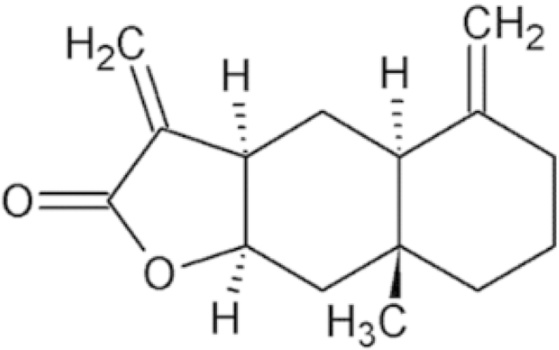
Isoalantolactone chemical structure.
재료 및 방법
실험재료 – 본 연구에 사용된 Isoalantolactone (ISA)은 Merkkorea (Gangnam-Gu, Republic of Korea)에서 구입하였다. 이 연구에 사용된 모든 시약은 분자 생물학 등급으로 구입하였다.
세포배양 – 본 연구에 사용된 Human hair follicle dermal papilloma (hHFDP) 세포는 Abm Inc. (New York, NY, USA)에서 구입하였고 3T3-Wnt reporter 세포주는 Enzo life science (Farmingdale, NY, USA), 그리고 HEK-Blue-STAT6 세포주는 BPS bio science (San Diego, CA 92121, USA)로부터 구입하였다. hHFDP 세포는 Antibiotic/Antimycotic Solution (HyCloneTM, Marlborough, MA, USA)는 penicillin 100 U/ml과 streptomycin 100 µg/ml의 농도로, 3T3-Wnt 세포주는 puromycin (10 µg/ml), penicillin (100 U/ml)과 streptomycin (100 µg/ml) 그리고, HEK-Blue-STAT6 세포주는 blasticidin 10 µg/ml (Gibco, NY, USA), zeocin 100 µg/ml (Invivo gene, San Diego, CA, USA), penicillin (100 U/ml)과 streptomycin (100 µg/ml)의 농도로 사용하였고 10% Fetal Bovine Serum (FBS) (HyCloneTM, Marlborough, MA, USA)가 함유된 Dulbecco's Modified Eagle's Medium (DMEM) (CORNING, corning, NY, USA), 배지로 37°C, 5% CO2 배양기에서 배양하였다.
hHFDP 세포를 이용한 세포 성장 측정(Cell growth assay) – hHFDP 세포는 96-well plate에 5×10³ cells/well 되도록 분주하였고 5% (v/v) CO2를 포함하는 습한 대기 조건의 37°C 환경에서 24시간 배양 후, ISA 추출물은 0.1~10 μM 또는 양성대조군 토파시티닙(tofacitinib) (Sigma-Aldrich, Burlington, MA, USA)는 0.01~1 µM 농도별로 처리 후 24시간 동안 배양하였다. Luciferase activity는 대사 활성 세포의 존재를 나타내는 ATP의 정량을 기반으로 배양액에서 생존 세포의 수를 결정하는 방법인 CellTiter-Glo® Luminescent Cell Viability Assay kit (Promega Corp., Madison, WI, USA)를 이용하여 LuBi luminometer (Berthold TEC GmbH & Co., OakRidge, TN, USA)를 통해 측정하였다. 모든 실험은 세번 반복하여 결과를 얻었으며 평균값은 표준편차(mean ± standard error of the mean (S.E.M.))로 나타내었다.
실시간 세포 성장 분석 시스템(Real time cell growth Assay) – xCELLigence 시스템(ACEA Biosciences; San Diego, CA, USA)은 전자 세포 센서 어레이를 사용하여 세포 증식, 세포 독성, 부착, 생존 가능성, 침입 및 이동과 같은 세포 과정을 라벨 없이 실시간으로 모니터링 할 수 있다. 세포 지수 (CI) 값으로 표시되는 전극 임피던스는 세포 수, 생존율, 형태 등 세포의 생물학적 상태에 대한 정량적 정보를 제공하는 데 사용되었다. 세포 형태, 세포 접착 또는 세포 생존 가능성과 같은 세포 상태의 변화는 well에 존재하는 세포 수를 정량적으로 측정하는 CI의 변화로 나타내었다. xCELLigence시스템의 E-plate 각 well에 DMEM(10% FBS, Antibiotic/Antimycotic Solution) 배지 150 μl 분주한 후 E-plate을 시스템에 연결하고 전기적 접촉이 적절한지 확인하고 24시간 동안 37°C, 5% CO2 배양기에서 기본 값을 측정하였다. 24시간 후 hHDFP 세포를 E-plate의 well에 2 × 10⁴ cell 분주한 후 24시간 37°C, 5% (v/v) CO2 배양기에서 배양 후 0~3 μM 농도별로 ISA를 처리하여 세포의 성장을 최대 96시간 동안 실시간으로 측정하였다. 세포의 성장을 전기 임피던스는 xCELLigence 시스템의 RTCA 통합 소프트웨어를 통해 CI값으로 측정하였다. 세 번의 실험을 반복하여 결과값을 얻었으며, 그 결과는 mean ± standard error of the mean (S.E.M.)으로 나타내었다.
Reporter gene 활성 측정(Luciferase assay) – TCF/LEF luciferase 구조체로 형질 발현된 3T3-Wnt 세포는 96-well plate에 3×10³ cells/well을 분주하여 24시간동안 배양기에서 배양한 후 3T3-Wnt 세포는 Wnt 3a (50%, v/v), tofacitinib 0.4 µM 또는 ISA 농도별 0.03~10 µM로 처리하여 48시간 동안 배양하였다. STAT6-luciferase로 형질 감염된 HEK-blue 세포는 96-well plate에 5×10³ cells/well을 분주한 후 24시간 배양기에서 배양한 후 interleukin 4 (IL-4) 10 ng/ml (Sigma-Aldrich, Burlington, MA, USA)를 단독 또는 tofacitinib 0.4 µM 와 ISA 농도별 0.03~10 µM 혼합하여 배양하였다. 세포들의 배양은 10% FBS를 함유된 DMEM배지로 5% (v/v) CO2를 포함하는 습한 대기 조건의 37°C 환경에서 자라도록 하였다. Luciferase activity은 luciferase assay kit (Promega Corp., Madison, WI, USA)을 이용하여 LuBi luminometer (Berthold TEC GmbH & Co., OakRidge, TN, USA)를 통해 측정하였다. 세 번의 실험을 반복하여 결과값을 얻었으며, 그 결과는 mean ± standard error of the mean (S.E.M.)으로 나타내었다.
단백질 발현 분석(Immunoblot assay) – hHDFP 세포를 100 mm Plate에 2.5×10⁴ cells 분주한 뒤 IL-6 또는 IL-4을 단독 처리한 것과 ISA (0.3~10 µM)농도별 또는 Tofacitinib 0.4 µM과 함께 처리한 것을 10% FBS를 함유하는 DMEM 배지에서 37°C, 5% (v/v) CO2 배양기에서 48시간 배양하였다. 배양된 세포들은 RIPA (Radio-ImmunoPrecipitation Assay) lysis buffer (50 mM Tris-HCl, pH 8.0, 150 mM NaCl, 1% IGEPAL CA-630, 0.1% sodium dodecyl sulfate (SDS), 1X Protease inhibitor cocktail)로 용해하였다. 분리된 단백질은 PierceTM BCA Protein Assay Kit (Thermo Fisher Scientific Inc. Waltham, MA, U.S.)의 제시된 방법을 따라 단백질을 정량하여 단백질(20 µg)을 NovexTM WedgeWellTM 8-10% 또는 4 -20%, Tris-Glycine SDS-PAGE (Invitrogen, Waltham, MA, USA)를 사용하여 분리하였다. Immunoblotting에 의해 β-actin (Sigma-Aldrich, Burlington, MA, USA), β-catenin, p-β-catenin, STAT6, p-STAT6, Erk1/2, p-Erk1/2 그리고 STAT3 (Santa Cruz Biotechnology, Dallas, TX, USA) 발현 양상을 ChemiDoc imaging system (BIORAD, Hercules, CA, USA)을 사용하여 측정하였다. 발현양상은 3회 반복하여 실시하였다.
In vivo 모발 성장 분석 – 7주령 암컷 C57BL/6 마우스를 Oriental Bio Co (Seoul, Republic of Korea)에서 구입했으며 23±3°C의 온도와 50±10%의 상대 습도를 조절된 명암 주기로 자동 유지하는 7일간의 적응 기간 후 동물을 2개의 무작위 그룹(n=3)으로 나누어 ISA의 모발과 모낭세포 성장 활동 측정하였다. 마우스 등 부위를 전기 제모기(electric clipper)로 제모하고 군당 3마리씩 2개 군으로 군 분리하여 ISA 3 μM농도를 1일 1회 200 μl씩 15일 동안 하루에 두 번씩 경피도포하였다. 모발 성장 시험에 사용된 시약은 50% 에탄올이 포함된 용액에 녹여 사용하였다. 모든 동물은 충북 동물실험 윤리위원회(Institutional Animal Care and Use Committee, Chungbuk, Republic of Korea)에서 승인한 프로토콜에 따라 관리되었다.
통계처리 – 모든 실험은 3회 반복 실험실시 하였고 실험 결과는 SPSS Subscription (IBM SPSS Statistics Inc, USA)를 이용하여 통계적 유의성을 검정하였다. 대조군 및 실험군 간의 통계적 유의성 검증은 Student’s t-test와 One-way ANOVA (Graph Pad Prism 5 software, La Jolla, CA, USA)를 사용하여 통계적 유의수준은 **P < 0.01에서 판단하였다.
결과 및 고찰
ISA의 모낭진피유두(hHFDP) 세포 성장에 미치는 영향 – ISA의 모발 성장 효과를 평가하기 위해 ISA 에탄올 추출물이 hHFDP 세포의 성장에 미치는 영향을 조사하였다. hHFDP 세포의 성장 효과는 ATP를 측정하는 방법으로 진행되었으며 양성 대조군으로 STAT6 활성 억제 효과가 보고되어 있는 tofacitinib을 사용하였다.18,19) ISA의 in vitro 실험 농도는 0.1~10 μM으로 설정하여 모낭세포(hHFDP)에 대한 생물학적 활성을 평가하였다. 이는 선행 연구에서 보고된 유사 구조 화합물의 활성 범위를 참고하였으며, 예비 세포독성 시험에서 전 농도에서 세포 생존율이 90% 이상으로 확인된 것을 바탕으로 하였다.
ISA 처리군은 무처리군에 비해 hHFDP세포 성장율 분석 결과 양성 대조군 tofactinib과 동일하게 ISA처리군에서도 농도 의존적으로 증가하는 결과를 보여주었다(Fig. 2). 또한 ISA의 hHFDP세포 성장 효과를 실시간으로 진행한 결과, ISA (0.01~3 µM) 농도별 그리고 양성 대조군 tofacitinib 0.4 µM을 처리하여 총 96시간 동안 분석한 결과 무처리군과 비교하였을 때 hHDFP 세포 성장율이 시간 의존적으로 증가하면서 차이를 나타내었다(Fig. 3). 특히 ISA 3 μM 농도에서 모발 성장 관련 지표의 발현 증가와 세포 증식이 가장 유의하게 나타났으며, 이에 따라 in vivo 실험의 처리 농도는 3 μM에 해당하는 수준으로 설정하였다. 따라서 본 연구에서는 ISA가 시험관내(in vitro)에서 hHFDP 세포의 증식에 미치는 효과와 생체내(in vivo)에서 모발 성장에 미치는 효능을 진행하였다.
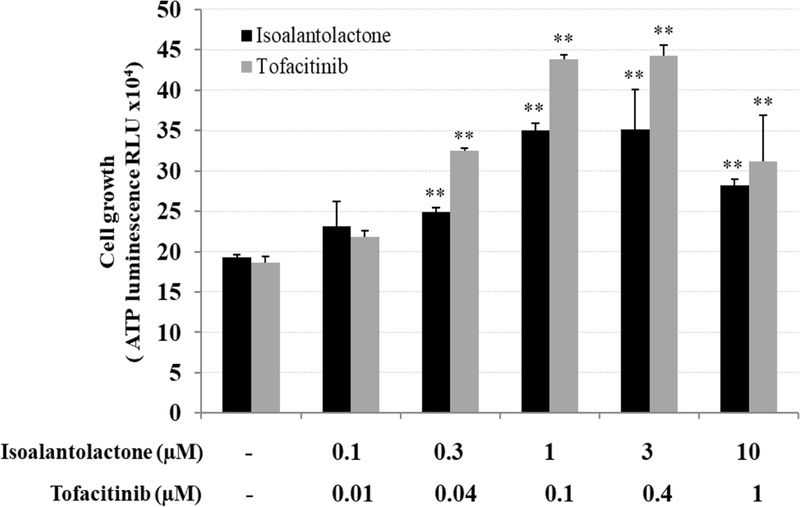
Cell Growth efficacy of isoalantolactone on hHFDP cells. To evaluate the effect of isoalantolactone on hHFDP cell growth, 1×10³ cells/well were seeded in 96 wells, treated with isoalantolactone (0.1-10 μM) and cultured for 24 h. Tofacitinib (0.01-1 μM was used as a positive control. CellTiter-Glo® luminescent cell growth assay as described in the Methods. All experiments were performed in triplicate. Asterisks indicate significant statistical significance (**p < 0.01).
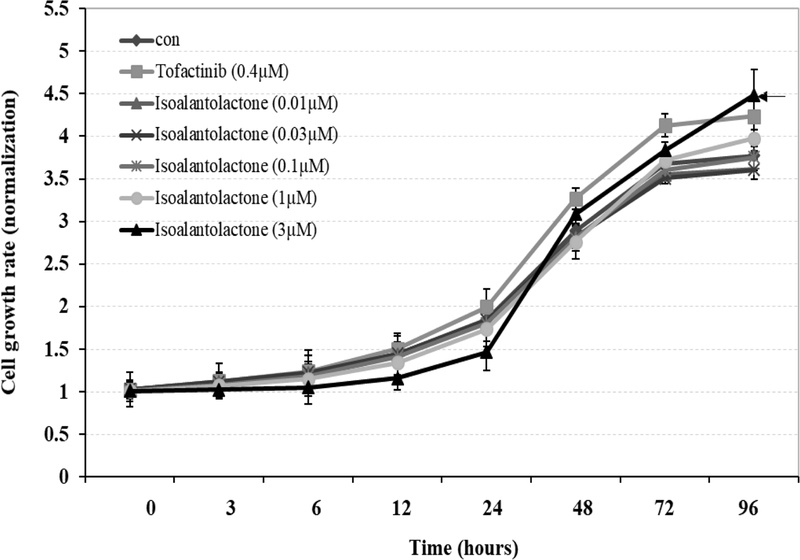
Cell growth analysis of isoalantolactone using a real-time cell analysis system. After adding 150 μl of medium per well, background impedance was measured for 24 h. Then, hHDFP cells were resuspended and adjusted to 2 × 10⁴ cells per well. Then, 50 μl of cell suspension and 150 μl of medium were added per well. After 24 h, 0–3 μM ISA and 200 μl of medium were added and monitoring was performed for up to 96 h. Tofacitinib 0.4 μM was used as a positive control.
ISA의 모발 관련된 Reporter gene 활성에 미치는 영향 – 다음으로 ISA가 hHFDP 세포의 증식을 촉진하는 세포내 분자생물학적 기전을 평가하였다. 따라서 모발 성장 신호조절에서 중요한 역할을 하는 TCF/LEF와 STAT6 luciferase reportor gene의 활성에 대한 ISA의 영향을 측정하였다.
최근 연구에 따르면, 모발이 휴지기에서 성장기로 전환될 때 β-catenin의 발현이 증가하고, Wnt 신호 전달 억제제인 Dkk1의 과발현은 모발 성장을 억제한다.20) 또한, Wnt 수용체 복합체의 구성 요소 중 하나인 Dishevelled의 활성화는 GSK-3β를 억제하여 세포질 β-catenin을 안정화시키고 전사를 위해 핵으로 이동한다. 따라서 GSK-3β를 억제하면 Wnt 신호 전달 경로가 활성화되어 모발 성장이 촉진된다고 보고되었다.21) 본 연구에서는 TCF/LEF luciferase reporter gene 시스템을 이용하여 Wnt 신호전달 경로를 확인하였다. 그 결과 ISA로 처리한 hHFDP 세포에서 TCF/LEF luciferase 활성은 농도 의존적으로 증가되었으며, 대조군으로 사용된 tofactinib과 비교하여 더 높은 활성 증가를 보였다(Fig. 4a). ISA는 모발 성장의 초기 조절 표적 유전자인 WNT/β-catenin신호경로를 조절함을 알 수가 있다. 양성 대조군으로 사용된 Wnt3a 처리군에서는 TCF/LEF reporter gene의 활성이 증가됨을 확인하였다.
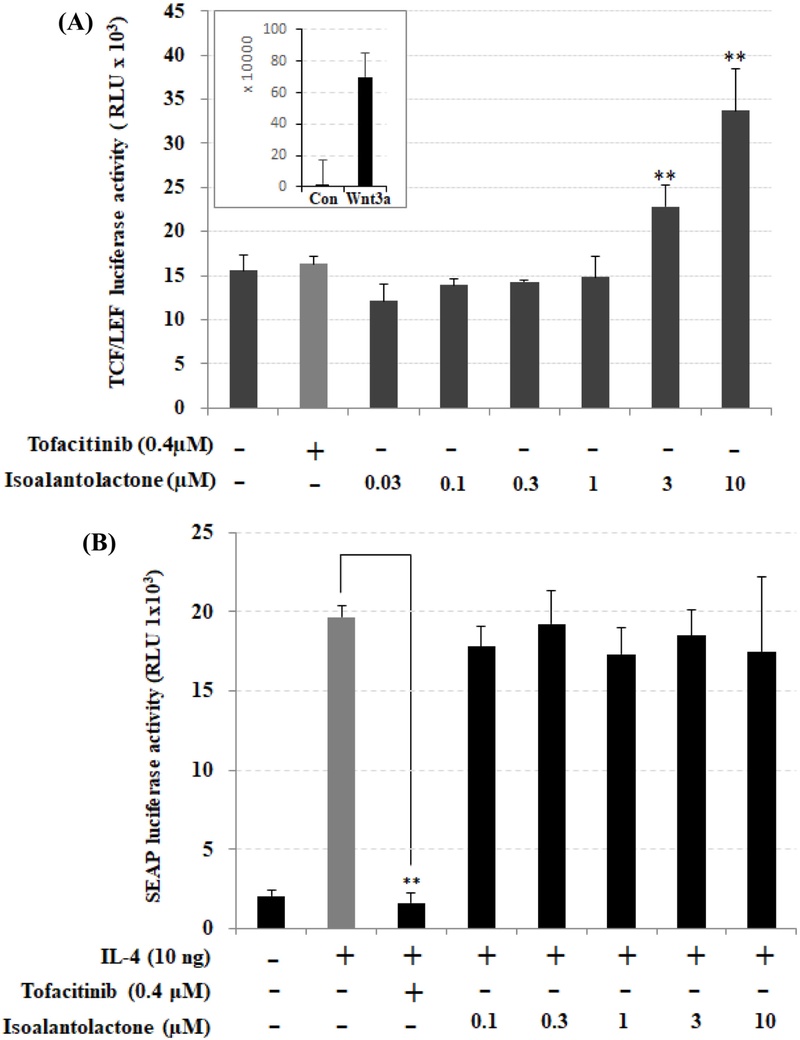
Effect of isoalantolactone using reporter gene assay. 3T3-Wnt cells transfected with the TCF/LEF luciferase construct were seeded in 96-well plates (3 × 10³ cells/well) and maintained in DMEM medium containing 10% FBS for 24 h. HEK-blue cells transfected with STAT6-luciferase were seeded in 96-well plates (5 × 10³ cells/well) and maintained in DMEM medium containing 10% FBS for 16-20 h. (A) 3T3-Wnt cells were treated individually with Wnt 3a (50%, v/v), tofacitinib (0.4 µM), and/or isoalantolactone (0.03–10 µM) and cultured for 48 h. (B) Interleukin 4 (IL-4) 10 ng/ml alone or mixed with tofacitinib 0.4 µM and/or isoalantolactone (0.03–10 µM) and cultured for 48 h, followed by luciferase measurement using the Phospha-Light System.
또한, ISA가 STAT6 luciferase 활성에 미치는 영향을 평가하기 위해, STAT6 reporter gene을 포함한 HEK-BlueTM IL-4/IL-13 세포를 IL-4로 처리하고, ISA 또는 tofactinib을 동시에 처리하여 비교하였다. 그 결과 양성 대조군인 tofactinib 처리군에서는 STAT6 luciferase 활성이 감소하였으나 ISA (0.1~10 μM) 처리군에서는 변화가 없을 관찰하였다(Fig. 4b). ISA는 IL-4-JAK-STAT6 신호 전달의 조절에는 영향이 없음을 알 수가 있다.
hHFDP 세포에서 ISA의 모발 성장을 조절하는 단백질 발현에 미치는 영향 – 신호전달 시스템인 TCF/LEF 그리고 STAT6 reporter gene 분석 결과를 기반으로 ISA가 모발 성장 관련 단백질 발현에 미치는 효과를 분석하였다. 우선 WNT/β-catenin 경로의 경우 Wnt신호의 유무에 따라 β-catenin의 분해가 결정된다. Wnt신호가 활성화되면 β-catenin의 인산화를 억제하여 glycogen synthase kinase 3β (GSK3β) 복합체로부터 분해되지 않고 핵 안으로 전위되어 TCF/LEF 유전자에 결합 후 표적 유전자를 발현시킨다. 반대로 Wnt신호가 비활성화되면 β-catenin은 인산화 되어 GSK3β 복합체에 의해 분해되어 소멸된다.22) 본 이론을 기반으로 모발 주요 단백질의 발현 양상을 관찰하였다. ISA를 처리한 그룹은 양성 대조군보다 p-β-catenin의 발현은 억제되면서 β-catenin은 과발현됨을 확인하였다(Fig. 5A). 또한 Wnt신호 전달 체계에 영향을 받는 세포의 성장 유도 단백질인 ERK1/2에서는 ERK1/2의 인산화 발현이 증가함을 확인하였다. ERK의 상위 조절인자인 PI3K/AKT 및 Ras/MAPK 신호전달 체계는 Wnt 신호 전달 체계와 연결되어 있다. PI3K가 활성화되면 세포 주기, 세포 생존 및 대사 조절에 관여하는 경로의 매개체인 AKT가 활성화되고 AKT는 GSK3β를 비활성화하여 β-catenin이 핵 안으로 전위된다.23) 본 실험 분석 결과 ISA는 ERK1/2 단백질의 인산화를 농도의존적으로 발현시킴을 확인할 수 있었다(Fig. 5A). 다음으로 JAK/STAT family인 STAT6와 STAT3의 단백질 발현양상을 관찰하였다. STAT6의 활성화는 탈모를 유발한다. JAK1/3 억제제인 tofacitinib은 STAT6의 발현을 억제함으로써 탈모 치료에 효과적인 것으로 보고된 바 있다.24,25) 또한 STAT3는 모발 성장 주기를 유도하는 것으로 알려져 있으며, 과립구 집락 자극 인자(G-CSF), 인터루킨-6(IL-6), 상피성장인자(EGF), 간세포성장인자(HGF) 등의 다양한 성장인자와 사이토카인에 의해 유도된다.26-28) ISA가 IL-4에 유도되는 STAT6 단백질의 발현에 미치는 영향을 확인하였으나 STAT6 reporter gene 분석 결과와 마찬가지로 ISA는 STAT6의 발현을 조절하지 못하였다. IL-6에 의한 STAT3의 단백질 발현 또한 조절하지 못함을 알 수가 있다(Fig. 5B).
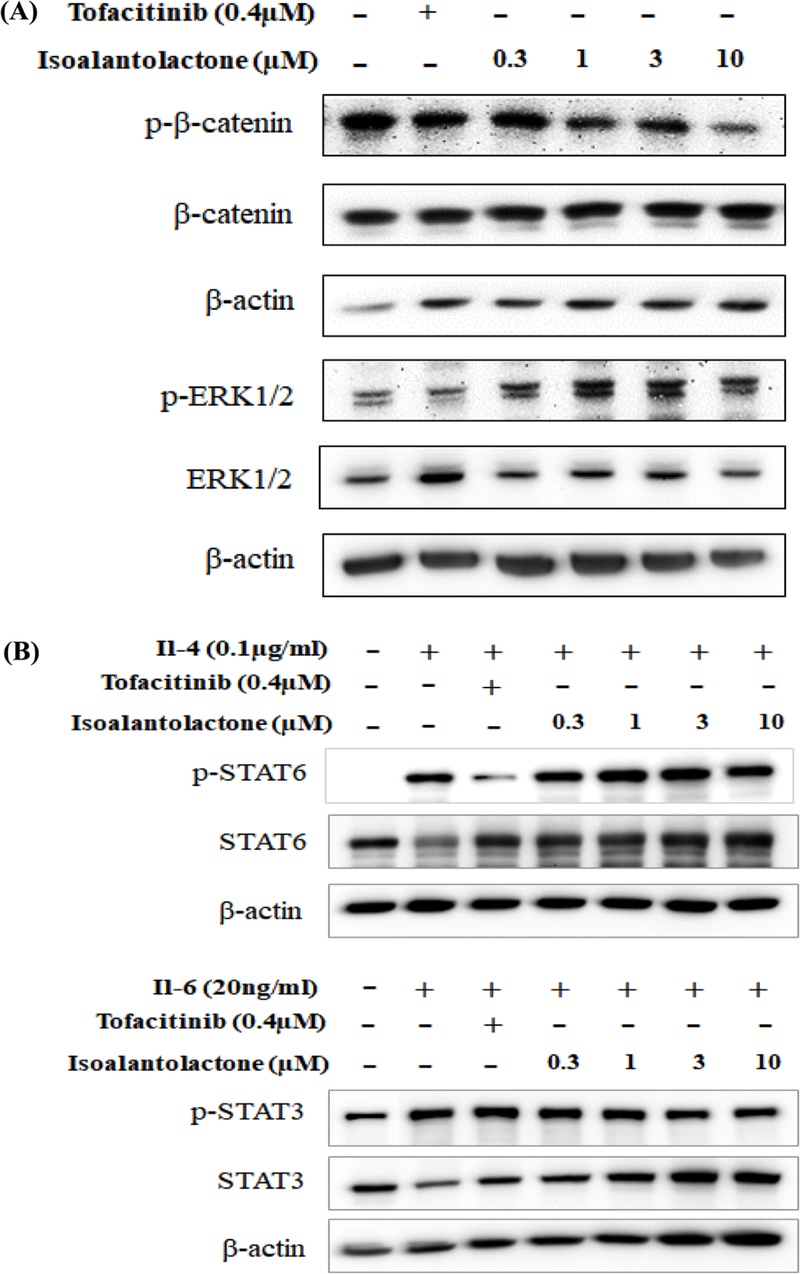
Analysis of the efficacy of isoalantolactone on the expression and inhibition of hair growth-regulating proteins. To evaluate protein expression in response to isoalantolactone at various concentrations, hHFDP cells were seeded in 100-mm plates (2.5 × 10⁴ cells/ml) and then treated with IL-6, IL-4 alone, or together with isoalantolactone (0.3–10 µM) and/or tofacitinib (0.4 µM). Each sample was cultured for 48 h. (A) β-catenin, p-β-catenin, ERK1/2, and p-ERK1/2 were measured after incubation with isoalantolactone (0.3–10 µM) or tofacitinib (0.4 µM) alone, and overexpression was observed at high concentrations of isoalantolactone. (B) p-STAT6, STAT6, p-STAT3, and STAT3 were measured after incubation with IL-6, IL-4 alone or with isoalantolactone (0.3–10 µM) and/or tofacitinib (0.4 µM). All experiments were confirmed by quantification with β-actin.
생체내(in vivo) 모델에서 ISA의 모발 성장에 미치는 영향 – 인체적용시험 진행 전 예비 실험의 일환으로 소규모의 마우스(C57BL/6 mouse) 모델 실험을 통해 ISA가 생체내에서 모발 성장에 미치는 결과를 예측하고자 진행하였다. 마우스의 등의 털을 면도한 후 7일간 대조군(에탄올) 또는 ISA를 국소적으로 처리한 그룹을 비교하였다. 그 결과 ISA를 처리한 그룹에서 대조군에 비하여 월등한 모발 성장을 보였다. 부검 시 모낭층과 진피층을 포함한 마우스 피부의 조직병리학적 분석 결과, ISA가 투여된 마우스에서 모낭의 직경과 깊이가 현저하게 증가함을 관찰하였다(Fig. 6).
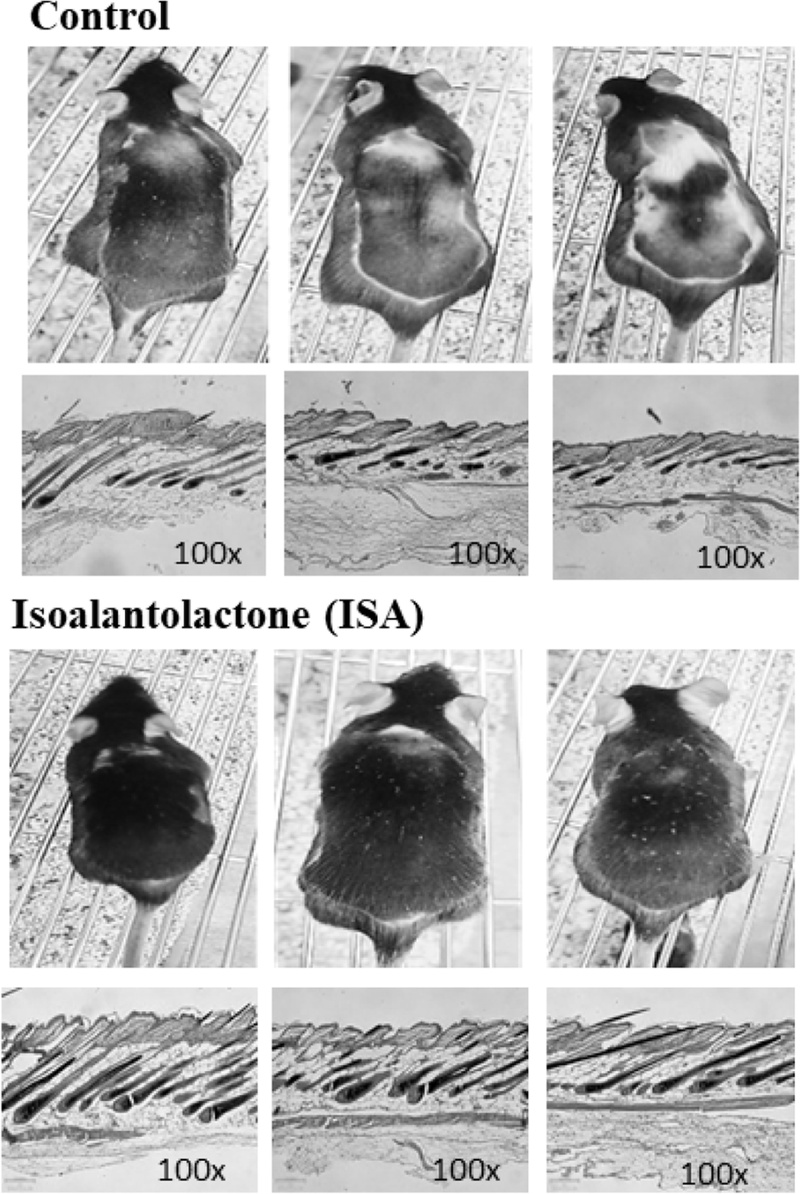
Enhanced anagen induction by natural extract in 7-week C57BL/6 mice. After quiescent synchronization, the shaved backs of C57BL/6 mice were treated topically with isoalantolactone or ethanol for 7 weeks. Control-ethanol (50%). Isoalantolactone (3 µM). Typical photographs of back skin (left panels) and histopathological analysis (right panels).
결 론
ISA는 Aucklandia lappa(토목향) 뿌리에서 유래한 성분 중 하나로, 다양한 암세포에서 활성산소종(ROS) 생성을 증가시키고 세포자멸사(Apoptosis)를 유도하여 항암 효과를 나타내며, 염증성 사이토카인 생성을 억제함으로써 항염 효과를, 또한 미생물의 생장을 억제하여 항균 및 항진균 효과를 보이는 것으로 알려져 있다. 29,30) 그러나 현재까지 ISA의 모발 성장이나 탈모와 관련된 연구는 보고된 바 없기에, 본 연구에서는 토목향의 주요 성분 중 하나인 ISA의 모발 성장 효과에 대한 과학적 근거를 마련하고자 하였다. 그 결과, in vitro 실험에서 ISA는 인간 모낭 진피유두세포(hHFDP)의 성장을 촉진하였으며, 모발 성장 조절에 핵심적인 WNT/β-catenin 및 Ras/MAPK 신호 전달 경로를 활성화하는 것으로 나타났다. 또한, 마우스 모델을 이용한 실험에서도 ISA가 모발 성장을 유도하는 효과가 확인되었다. 이러한 결과는 ISA가 모발 성장 촉진과 탈모 예방에 효과적인 천연 유래 성분으로서, 모발 토닉이나 샴푸와 같은 제품으로 개발될 가능성을 시사한다. 향후 인체적용 시험을 통해 임상적 효능을 보다 명확히 검증할 수 있을 것으로 기대된다.
References
- Lee, S. H. and Lee J. R. (2010) Association of diffuse hair loss of adult male on stress, self-confidence, and depression. Jounal of The Korean Society of Cosmetology 16: 1171-1179.
- Kim, D. H. and Kim, S. N. (2010) The effect on hair loss for impression formation and interpersonal anxiety. Asian J. Beauty Cosmetol. 8: 247-258.
- Phillips, T. G., Slomiany, W. P. and Allison, R. (2017) Hair loss: common causes and treatment. American Family Physician 96: 371-378.
-
Laura, A. and Fuchs, E. (2006) The hair cycle. Journal of Cell Science 119: 391-393.
[https://doi.org/10.1242/jcs.02793]

-
Enshell-Seijffers, D., Lindon, C., Kashiwagi, M. and Morgan, B. A. (2010) β-Catenin activity in the dermal papilla regulates morphogenesis and regeneration of hair. Developmental Cell 18: 633-642.
[https://doi.org/10.1016/j.devcel.2010.01.016]
-
Andl, T., Reddy, S. T., Gaddapara, T. and Millar, S. E. (2002) WNT signals are required for the initiation of hair follicle development. Developmental Cell 2: 643-653.
[https://doi.org/10.1016/S1534-5807(02)00167-3]
-
Myung, P. S., Takeo, M., Ito, M. and Atit, R. P. (2013) Epithelial Wnt ligand secretion is required for adult hair follicle growth and regeneration. Journal of Investigative Dermatology 133: 31-41.
[https://doi.org/10.1038/jid.2012.230]
-
Hebenstreit, D., Wirnsberger, G., Horejs-Hoeck, J. and Duschl, A. (2006) Signaling mechanisms, interaction partners, and target genes of STAT6. Cytokine & Growth Factor Reviews 17: 173-188.
[https://doi.org/10.1016/j.cytogfr.2006.01.004]
-
Dhariwala, M. Y. and Ravikumar, P. (2019) An overview of herbal alternatives in androgenetic alopecia. Journal of Cosmetic Dermatology 18: 966-975.
[https://doi.org/10.1111/jocd.12930]
-
Jang, I. W., Ko, W. S. and Yoon, H. J. (2015) The latest trends of treatment for alopecia. The Journal of Korean Medicine 28: 12-28.
[https://doi.org/10.6114/jkood.2015.28.4.012]
-
Kim, Y. E., Choi, H. C., Lee, I. C., Yuk, D. Y., Lee, H. and Choi, B. Y. (2016) 3-Deoxysappanchalcone promotes proliferation of human hair follicle dermal papilla cells and hair growth in C57BL/6 mice by modulating WNT/β-Catenin and STAT signaling. Biomolecules & Therapeutics 24: 572.
[https://doi.org/10.4062/biomolther.2016.183]
-
Kim, Y. E., Choi, H. C., Nam, G. and Choi, B. Y. (2019) Costunolide promotes the proliferation of human hair follicle dermal papilla cells and induces hair growth in C57BL/6 mice. J. Cosmet. Dermatol 18: 414-421.
[https://doi.org/10.1111/jocd.12674]
-
Kim, B. H., Lee, M. J., Lee, W. Y., Pyo, J., Shin, M. S., Hwang, G. S., Shin, D., Kim, C. E., Park, E. S. and Kang, K. S. (2021) Hair growth stimulation effect of centipeda minima extract: Identification of active compounds and anagen-activating signaling pathways. Biomolecules 11.
[https://doi.org/10.3390/biom11070976]
-
Serruya, R. and Maor, Y. (2021) Hair growth-promotion effects at the cellular level and antioxidant activity of the plant-based extract Phyllotex. Heliyon 7: e07888.
[https://doi.org/10.1016/j.heliyon.2021.e07888]
-
Shin, J. Y., Choi, Y. H., Kim, J., Park, S. Y., Nam, Y. J., Lee, S. Y., Jeon, J. H., Jin, M. H. and Lee, S. (2020) Polygonum multiflorum extract support hair growth by elongating anagen phase and abrogating the effect of androgen in cultured human dermal papilla cells. BMC Complement Med. Ther. 20: 144.
[https://doi.org/10.1186/s12906-020-02940-5]
-
Yang, G., Yang, L. and Xu, F. (2024) Isoalantolactone: a review on its pharmacological effects. Frontiers in Pharmacology 15: 1453205.
[https://doi.org/10.3389/fphar.2024.1453205]
-
Xu, L., Sun, Y., Cai, Q., Wang, M., Wang, X., Wang, S. and Ni, Z. (2023) Research progress on pharmacological effects of isoalantolactone. Journal of Pharmacy and Pharmacology 75: 585-592.
[https://doi.org/10.1093/jpp/rgac103]
-
Vanhoutte, F., Mazur, M., Voloshyn, O., Stanislavchuk, M., Van der Aa, A., Namour, F. and Van't Klooster, G. (2017) Efficacy, safety, pharmacokinetics, and pharmacodynamics of filgotinib, a selective JAK‐1 inhibitor, after short‐term treatment of rheumatoid arthritis: results of two randomized phase IIa trials. Arthritis & Rheumatology 69: 1949-1959.
[https://doi.org/10.1002/art.40186]
-
Harel, S., Higgins, C. A., Cerise, J. E., Dai, Z., Chen, J. C., Clynes, R. and Christiano, A. M. (2015) Pharmacologic inhibition of JAK-STAT signaling promotes hair growth. Science Advances 1: e1500973.
[https://doi.org/10.1126/sciadv.1500973]
-
Rishikaysh, P., Dev, K., Diaz, D., Qureshi, W.M., Filip, S. and Mokry, J. (2014) Signaling involved in hair follicle morphogenesis and development. International Journal of Molecular Sciences 15: 1647-1670.
[https://doi.org/10.3390/ijms15011647]
-
Yamauchi, K. and Kurosaka, A. (2009) Inhibition of glycogen synthase kinase-3 enhances the expression of alkaline phosphatase and insulin-like growth factor-1 in human primary dermal papilla cell culture and maintains mouse hair bulbs in organ culture. Archives of Dermatological Research 301: 357-365.
[https://doi.org/10.1007/s00403-009-0929-7]
-
Choi, B. Y. (2020) Targeting Wnt/β-catenin pathway for developing therapies for hair loss. International Journal of Molecular Sciences 21: 4915.
[https://doi.org/10.3390/ijms21144915]
-
Sharma, M., Chuang, W. W. and Sun, Z. (2002) Phosphatidylinositol 3-kinase/Akt stimulates androgen pathway through GSK3β inhibition and nuclear β-catenin accumulation. Journal of Biological Chemistry 277: p30935.
[https://doi.org/10.1074/jbc.M201919200]
-
Wang, E. H. C., Sallee, B. N., Tejeda, C. I. and Christiano, A. M. (2018) JAK inhibitors for treatment of Alopecia areata. Journal of Investigative Dermatology 138: 1911-1916.
[https://doi.org/10.1016/j.jid.2018.05.027]
-
Dhillon S. (2017) Tofacitinib: a review in rheumatoid arthritis. Drugs 77: 1987-2001.
[https://doi.org/10.1007/s40265-017-0835-9]
-
Chen, Q., Quan, Y., Wang, N., Xie, C., Ji, Z., He, H., Chai, R., Li, H., Yin, S. and Chin, Y. E. (2017) Inactivation of STAT3 signaling impairs hair cell differentiation in the developing mouse cochlea. Stem Cell Reports 9: 231-246.
[https://doi.org/10.1016/j.stemcr.2017.05.031]
-
Sano, S., Kira, M., Takagi, S., Yoshikawa, K., Takeda, J. and Itami, S. (2000) Two distinct signaling pathways in hair cycle induction: Stat3-dependent and-independent pathways. Proceedings of the National Academy of Sciences 97: 13824-13829.
[https://doi.org/10.1073/pnas.240303097]
-
Akira S. (1997) IL-6-regulated transcription factors. The International Journal of Biochemistry & Cell biology 29: 1401-1418.
[https://doi.org/10.1016/S1357-2725(97)00063-0]
-
Lee, S. O., Joo, S. H., Lee, N. Y., Cho, S. S., Yoon, G., Kim, K. T., Choi, Y. H., Park, J. W., Choi, J. S. and Shim, J. H. (2025) Isoalantolactone induces the apoptosis of oxaliplatin-resistant human colorectal cancer cells mediated by ROS generation and activation of JNK and p38 MAPK. Scientific Reports 15: 14912-14923.
[https://doi.org/10.1038/s41598-025-98499-7]
-
Guang, Y., Longfei, Y. and Fei, X. (2024) Isoalantolactone: a review on its pharmacological effects. Front. Pharmacol. 15: 1-19.
[https://doi.org/10.3389/fphar.2024.1453205]